Back to Timeline
Timeline / Phase I

17th–19th Centuries

Early Migration within Southeast Asia

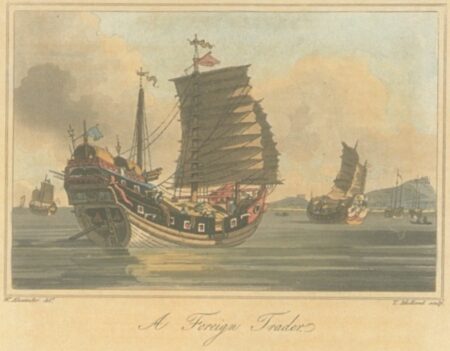
Sailing boat

1640s–1770s: Early Migration to Siam

Following the Qing dynasty's conquest of South China (c. 1644–1660s), significant Cantonese migration occurred. Ming loyalists and refugees fled south by sea to escape warfare, while widespread corruption and hardship under Qing rule compelled many farmers and artisans to seek livelihoods abroad.

Maritime routes linked Guangdong's coastal communities to Siam (Thailand), Cambodia, and Cochinchina, where local rulers welcomed Cantonese traders and skilled workers for their commercial and fiscal value.

By 1700, the Chinese population in Ayutthaya reportedly exceeded 3,000. This community expanded significantly throughout the 18th century, with Cantonese immigrants becoming prominent in royal monopolies, navigation, commerce, and urban crafts.

1680s–1790s: Establishment in Southern Vietnam

Around 1680, Mo Jiu, a refugee from Leizhou, Guangdong, developed the Hà Tiên area. He formally established a semi-autonomous principality there in 1708, placing it under the suzerainty of the Vietnamese Nguyễn lords. This polity functioned as a sanctuary and major hub for Cantonese and other Chinese migrants prior to French colonization.

During the Tây Sơn conflicts, ethnic Chinese merchants, primarily Cantonese, founded a new settlement adjacent to Saigon in 1778. This settlement evolved into Chợ Lớn ("Big Market"). Despite suffering severe persecution and violence in 1782, survivors rebuilt the community. By the end of the 18th century, the Cantonese population in Cochinchina was estimated at 30,000–40,000, controlling key rice and silk trade routes.

Antique Map of Southern Asia

Antique Map of Southern Asia by Walker (c.1840)

Initial Final

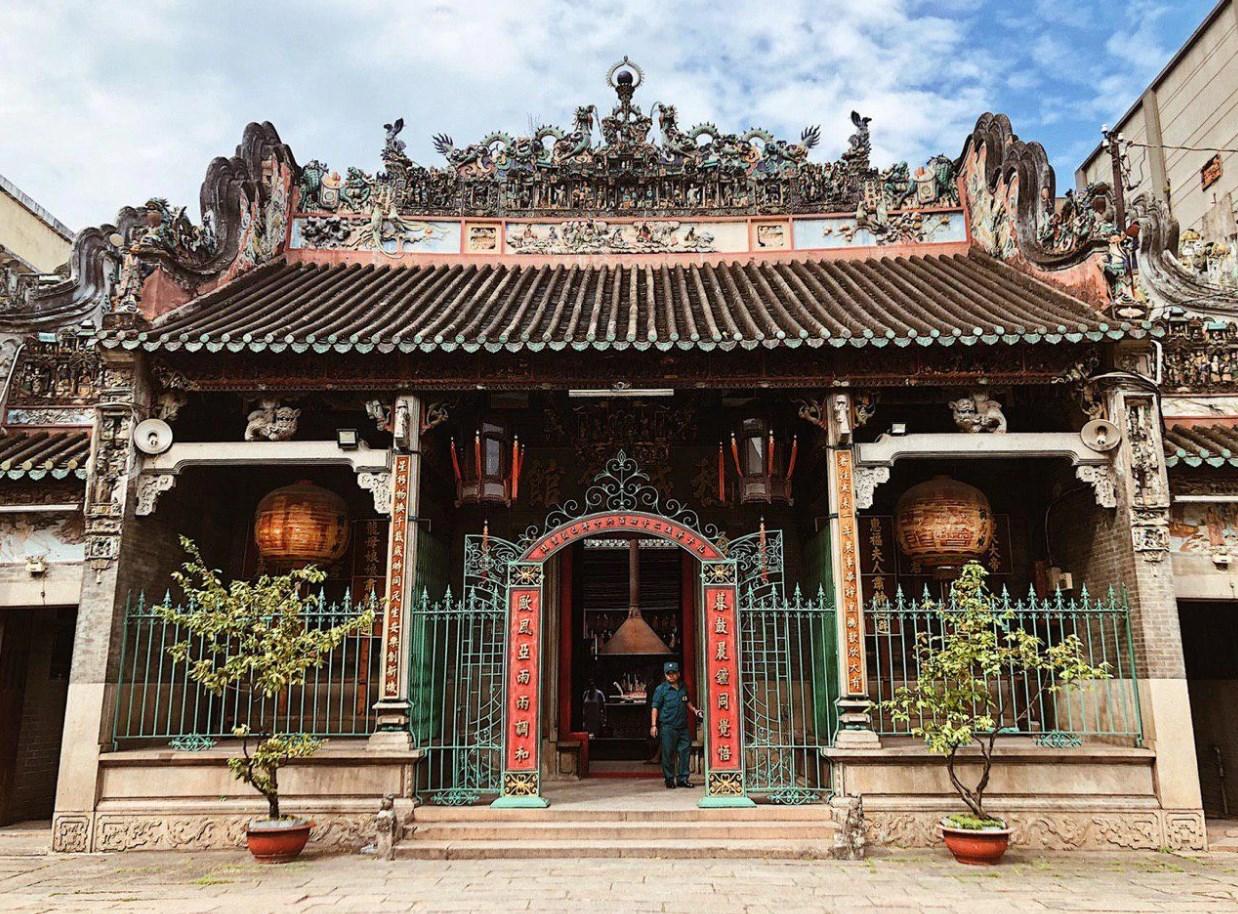
Thien Hau Temple, Saigon, established in 1760

Voyage

A voyage to Cochinchina, 1790s

1786–1820s: Expansion into British Colonial Ports

From the late 18th century, British colonial ports reshaped Guangdong migration routes. Penang (est. 1786) offered security and strong commercial prospects. In the 1790s, the Ghee Hin Kongsi emerged as one of the earliest major Chinese brotherhoods in Penang. Strongly associated with Cantonese networks, it organized labor, protection, and mutual aid, anchoring Cantonese community life in the Straits Settlements. Penang’s Ng Fook Thong (founded in 1819), often cited as an early Cantonese school in Malaya, also served as a temple gathering hub for Cantonese migrants.

Following the establishment of Singapore in 1819, Cantonese migrants integrated into the colony's expanding economy. In 1822, Cho Ah Chee established the first Cantonese dialect association, the Ning Yeung Wui Kuan. This marked a pivotal moment of institutional consolidation for Singapore's Cantonese community. By the early 1900s, many Cantonese migrants lived in Singapore shophouses, where shopfronts and upstairs lodging kept work and community tightly linked.

Penang School

Penang Ng Fook Thong (est. 1819)

Shophouses

Early 1900s Singapore Shophouses

1840s–1870s: The Malayan Tin Boom

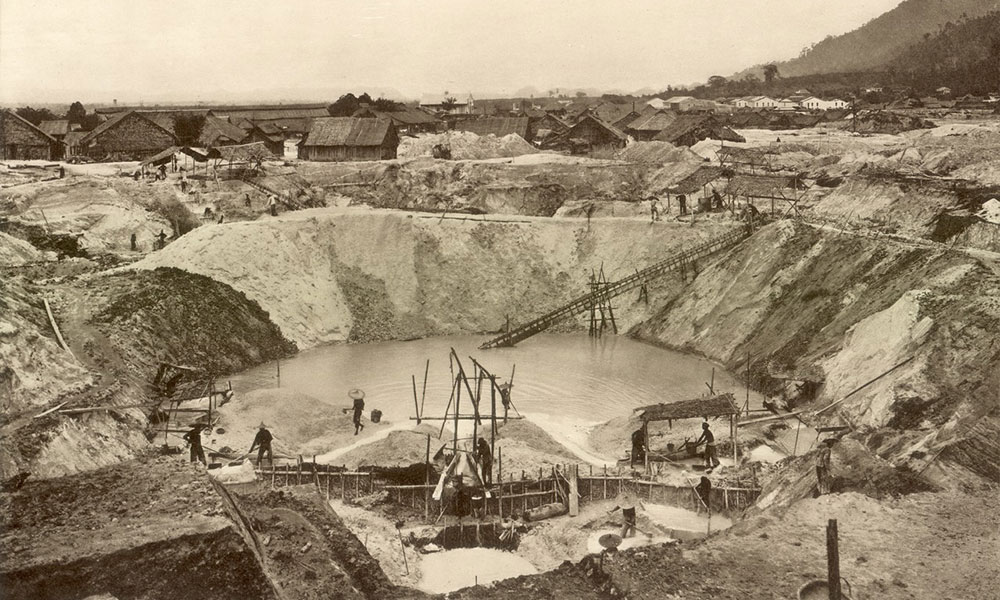
Tin Mine

Open-cast Tin Mine in Malaya, 1900s

With the discovery of rich tin deposits in Perak, Selangor, and Negeri Sembilan, a new wave of migration occurred between the 1840s and 1870s. During this period, Cantonese laborers and capitalists moved from Penang and Singapore into the interior mining districts of the Malay Peninsula.

Summary: Social Mobility

Loke Yew

Loke Yew (1846-1917). Cantonese migrant turned
Malayan tin tycoon and philanthropist.

By the turn of the 19th century, the total Cantonese population in Southeast Asia remained relatively modest, yet they occupied a unique niche. Through the Ghee Hin brotherhoods and clan associations, they organized both labor and capital. By the late 19th century, a distinct class of magnates emerged, controlling tin mines, revenue farms, and vast commercial networks.